
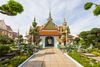
Must-See Temples in Bangkok
Bangkok's Most Important Temples and Wats
Bangkok is abundant with sacred sites and religious relics. While its Buddhist temples draw thousands of visitors each month with their giant hand-carved deities and ornate golden chedis (bell-shaped domes and spires), there are plenty of Taoist and Hindu temples too that will appeal to travelers who appreciate beautiful architecture.
The most famous of these is Wat Phra Kaew (home to a prized emerald Buddha that dates to the 15th century), Wat Arun, the Temple of Dawn, and Wat Pho, which showcases a huge reclining Buddha with feet encrusted with mother of pearl. Don’t miss Sri Maha Mariamman Temple for its elaborate façade featuring the Hindu faith’s gods and goddesses.
What are Bangkok’s must-see temples?
1. Wat Phra Kaew
Temple of the Emerald Buddha

Good for: History, Photo
Found within the grounds of the Grand Palace, Wat Phra Kaew or ‘The Temple of the Emerald Buddha’ is the most important and most visited temple in Bangkok. The Emerald Buddha is carved from a 66 cm block of jade. This highly revered icon was first discovered in 1464 in Chiang Rai when the wat sheltering it was struck by lightning. It was taken to Laos and Chiang Mai before it found a permanent home in Bangkok.
Wat Phra Kaew is a superb temple to explore, especially the 2 km long gallery of detailed mural paintings that depict 178 scenes of the epic story, Ramayana. Around every corner you’ll find tall chedis covered with glazed tiles or gold leaf. The most photographed building is the massive golden chedi of Phra Sri Rattana. A strict dress code applies here: no shorts or sleeveless shirts. Read more
Location: Na Phra Lan Rd, Phra Borom Maha Ratchawang, Phra Nakhon, Bangkok 10200, Thailand
Open: Daily from 8.30 am to 3.30 pm

Wat Phra Kaew
2. Wat Pho
Temple of the Reclining Buddha
Good for: History, Photo, Unusual
Wat Pho, named after a monastery in India where Buddha is believed to have lived, is one of the oldest and largest Buddhist temples in Bangkok. It’s also known as ‘The Temple of the Reclining Buddha’ thanks to its 15-meter-high, 43-meter-long Buddha statue, which is covered with gold leaf and bares mother-of-pearl encrusted feet.
Located next to the Grand Palace, Wat Pho houses 1,000 Buddha images and 91 chedis (stupas), including four very impressive chedis dedicated to the Chakri kings. Wat Pho is also home to the first Thai massage school. Just so you know, the temple’s full name is Wat Phra Chettuphon Wimon Mangkhlaram Ratchaworamahawihan (quite the tongue twister)! Read more
Location: 2 Sanam Chai Rd, Phra Borom Maha Ratchawang, Phra Nakhon, Bangkok 10200, Thailand
Open: Daily from 8 am to 7.30 pm
Phone: +66 83 057 7100
Wat Pho
3. Wat Arun
Temple of the Dawn
Good for: History, Photo
Wat Arun, the most iconic temple in Bangkok, is located on the Thonburi side of the Chao Phraya River, almost opposite to the Grand Palace and Wat Pho. Built during the 17th century, it consists of a central prang (a Khmer-style tower) surrounded by four smaller towers encrusted with pottery fragments. The stairs to reach the balcony on the main tower are quite steep (usually easier to climb up than to walk down) but the view from up top is really worth it.
Despite its name, the Temple of Dawn looks amazing at sunset. Wat Arun can easily be accessed via ferry across the Chao Phraya River (disembark at Maharaj Pier). Read more
Location: 158 Thanon Wang Doem, Wat Arun, Bangkok Yai, Bangkok 10600, Thailand
Open: Daily from 8 am to 6 pm
Phone: +66 2 891 2185
Wat Arun
4. Wat Saket
The Golden Mount
Good for: History, Photo
Wat Saket is the temple where you can visit the unmistakable golden Chedi of Phu Khao Thong or ‘the Golden Mountain’. Built on top of a high hill in the old city of Bangkok, this massive construction has a long and troubled history.
Built initially by King Rama III, the first attempt failed and the chedi collapsed because of the soft ground, and construction was abandoned. The golden chedi you see today was built during the reign of King Rama IV and Rama V and is actually built on the remains of the original one. Ascend the 300 steps that lead to the top terrace and to the chedi containing a relic of Buddha brought over from India. Read more
Location: 344 Chakkraphatdi Phong Rd, Ban Bat, Pom Prap Sattru Phai, Bangkok 10100, Thailan
Open: Daily from 7 am to 7 pm
Wat Saket
5. Wat Traimit
The Golden Buddha
Good for: History, Photo
Wat Traimit is an elegant, multilevel, white-and-gold temple located at the very beginning of Yaowarat Road (making it a perfect starting point for a Chinatown exploration). The main attraction of Wat Traimit is the immense Buddha made of solid gold which is seated inside—the largest of its kind in the world.
This 5-meter-high, 5.5-ton statue was long hidden under an unimpressive coating of stucco and plaster, thought to have been made in the 13th and 14th centuries. The gold hidden underneath was only revealed by accident in 1955! A small entry fee is required to visit the museum located halfway up the steps but visiting the golden Buddha is free. Read more
Location: 661 Charoen Krung Rd, Talat Noi, Samphanthawong, Bangkok 10100, Thailand
Open: Daily from 8 am to 5 pm
Phone: +66 89 002 2700
Wat Traimit
6. Loha Prasat
The Iron Palace
Good for: History, Photo
Bangkok isn’t lacking sacred or majestic temples and each is more elegant and impressive than the next, but Loha Prasat really stands out with its unique architectural identity.
Also called the ‘Metal Castle’, Loha Prasat is located on the grounds of Wat Ratchanaddaram and was submitted to UNESCO in 2005 to become a World Heritage site, highlighting the historical importance of the temple. Located near Wat Saket and the Democracy Monument, it’s a must-see if you happen to be around Khao San Road. Read more
Location: 2 Maha Chai Rd, Wat Bowon Niwet, Phra Nakhon, Bangkok 10200, Thailand
Open: Daily from 9 am to 5 pm
Phone: +66 2 224 8807
Loha Prasat
7. Wat Mahathat
Temple of the Great Relic
Good for: History, Photo
Wat Mahathat (or more precisely Wat Mahathat Yuwarajarangsarit Rajaworamahavihara) was built during the Ayutthaya period. It’s one of the 10 royal temples of the highest class in Bangkok, used for important ceremonies thanks to its strategic location between the Grand and Royal palaces.
Located within the temple grounds is the oldest higher education institute for Buddhist monks in Thailand (and an important center for the study of Buddhism and meditation). Wat Mahatat has become a popular place to learn Vipassana Meditation, with some classes undertaken in English. Just opposite is a sprawling amulet market (an absolute must-see). Read more
Location: Chikun Alley, Pratu Chai Sub-district, Phra Nakhon Si Ayutthaya District, Phra Nakhon Si Ayutthaya 13000, Thailand
Open: Daily from 8.30 am to 6.30 pm
Phone: +66 3 524 2286
Wat Mahathat
8. Wat Suthat Thepwararam
Divine Noble Monastery
Good for: History, Photo
Wat Suthat, famed for the red Giant Swing that stands at its entrance, is one of the oldest and most impressive temples in Bangkok. It features an elegant chapel with a sweeping roof, magnificent wall murals, and exquisite hand-carved teakwood door panels.
The temple’s construction was commissioned by King Rama I (1782-1809) to shelter the 13th-century bronze Buddha image transported by boat from Sukhothai, and was finally completed during King Rama III’s reign (1824-1851). Located in the Old City area, just east of the Royal Field, you can easily combine a visit to Wat Suthat with the Temple of the Emerald Buddha, the Grand Palace, and Wat Pho. Read more
Location: 146 Bamrung Mueang Rd, Wat Ratchabophit, Phra Nakhon, Bangkok 10200, Thailand
Open: Daily from 8.30 am to 8 pm
Phone: +66 63 654 6829
Wat Suthat Thepwararam
9. Wat Benjamabhopit
The Marble Temple
Good for: History, Photo, Unusual
Wat Benjamabhopit, most commonly called Wat Benja, was built by King Rama V in 1900 and is renowned for more than one reason. It’s nicknamed ‘The Marble Temple’ because all the external walls of the main temple are covered with marble imported from Italy. That said, it’s most famous for being the temple embossed on the back of Thailand’s 5 baht coins.
Located near Bangkok’s many government offices and palaces, this wat is highly revered and is often visited by high-ranked officials. It’s architecture typifies the city’s decorative style of high gables and ornate finials.
Location: 69 Rama V Rd, Dusit, Dusit District, Bangkok 10300, Thailand
Open: Daily from 6 am to 6 pm
Phone: +66 98 395 4289
Wat Benjamabhopit
10. Wat Bowon Niwet
Excellent Abode Monastery
Good for: History, Photo
Wat Bowon Niwet is located on Bangkok’s Rattanakosin Island, within the old city walls. It was founded in 1826 by HRH Prince Maha Sakdipolsep, a son of King Rama III. The complex features elaborately carved doorway arches and windows in gilded stucco. The gable is decorated with glazed ceramics, indicating strong Chinese influences. There are several rare and much revered Buddha statues, as well as a large chedi covered in gold tiles.
Its regal history dates back to the first abbot. This was none other than Prince Bhikku Mongkut, who later acceded the throne to become King Rama IV. King Rama VII and HM King Bhumibol Adulyadej were also ordained here, making this a major temple of patronage for the Chakri Dynasty.
Location: 248 Phra Sumen Rd, Wat Bowon Niwet, Phra Nakhon, Bangkok 10200, Thailand
Open: Daily from 6.30 am to 4 pm
Phone: +66 2 629 5854
Wat Bowon Niwet
11. Wat Intharawihan
Temple of the Standing Buddha
Good for: History, Photo, Unusual
A soaring, 32-meter-high standing Buddha is what defines Wat Intharawihan, which borders Wisut Kasat Road at the northern edge of Banglamphu. Known as the Luangpor Toh, the building of this statue began in 1867, during the reign of King Rama IV. Decorated in glass mosaics and 24-carat gold, it took over 60 years to complete.
The prayer room was built towards the end of the Ayutthaya period and has several interesting Buddha images, elevated murals on the walls, and lavishly gilded window shutters. Outside are unusually carved stones and, tucked away in an alcove, there’s a lifelike model of Luang Phaw Toh, a famous monk. In the small museum are old Buddha images and various paintings.
Location: 114 Wisut Kasat Road, Banglamphu, Phra Nakhon, Bangkok 10200, Thailand
Open: Daily from 6 am to 6 pm
Phone: +66 2 282 3173
Wat Intharawihan
12. Sri Maha Mariamman Temple
Indian Hindu Temple
Good for: History, Photo, Unusual
Sri Maha Mariamman Temple is a Hindu temple dedicated to the Goddess Mariamman. It was built by Tamil immigrants in the 1860s, featuring a riotous blend of rich colors and ornate decoration that makes for a rather unexpected sight in Silom. It’s a great site for a little taste of Indian architecture right in the heart of Bangkok.
The tall central structure is plastered with detailed, entwining Hindu deities. The shrines inside the temple are dedicated to both Shiva’s consort and the elephant-headed Ganesha, with others paying homage to Vishnu and Krishna.
Location: 2 Pan Rd, Silom, Bang Rak, Bangkok 10500, Thailand
Open: Monday–Thursday from 6 am to 8 pm, Friday from 6 am to 9 pm, Saturday–Sunday from 6.30 am to 8.30 pm
Phone: +66 97 315 9569
Sri Maha Mariamman Temple
This article includes opinions of the Go Guides editorial team. Hotels.com compensates authors for their writing appearing on this site; such compensation may include travel and other costs.